
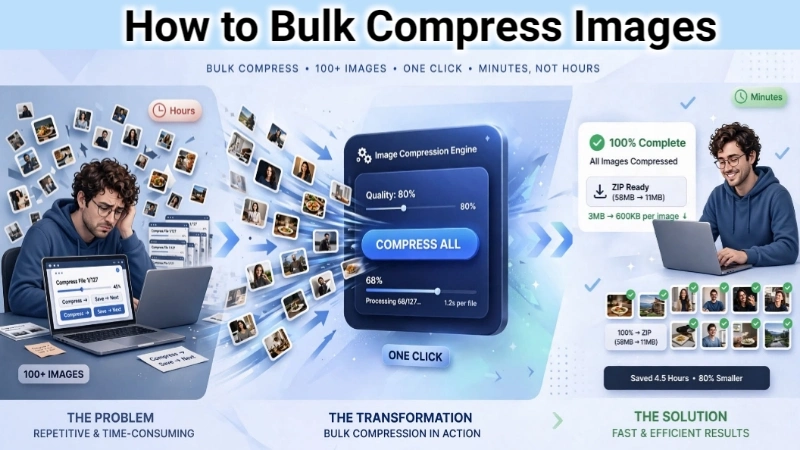
Let me tell you something that might sound familiar.
You just came back from a vacation. You have 300 photos on your phone. Or maybe you are a website owner with 500 product images. Or a real estate agent with 200 property photos.
And now you need to make all of them smaller. One by one.
Just thinking about it makes you tired, right?
I have been there. Opening each photo separately. Compressing it. Saving it. Opening the next one. Repeat 200 times. That is hours of boring, mind-numbing work.
But here is the good news. You do not have to do that anymore.
There is a smarter way. It is called bulk compress images. And it will change your life.
In this guide, I will show you exactly what bulk compress images means. I will explain how bulk images compressor tools work. And I will teach you how to do bulk photo compression in less time than it takes to watch a YouTube video.
No technical skills needed. No expensive software. Just simple steps that anyone can follow.
By the end of this article, you will be compressing 100 photos in under 60 seconds. Yes, really. Let me show you how.
![Image Prompt: A person sitting at a desk looking exhausted with a giant stack of printed photos next to them. On the computer screen, a progress bar shows “Compressing 247 images” and a timer says “8 seconds remaining.” A superhero cape appears behind the person. Humorous, relatable illustration style. 16:9 aspect ratio.]
Why Would You Need to Bulk Compress Images?
Before I show you the “how,” let me explain the “why.”
You might be wondering: “Why do I need to bulk compress images? Can’t I just do one at a time?”
Sure, you can. But here is what happens when you compress images one by one.
| Number of Images | Time One by One | Time with Bulk Compression |
|---|---|---|
| 10 photos | 5 to 10 minutes | 30 seconds |
| 50 photos | 25 to 50 minutes | 1 minute |
| 100 photos | 1 to 2 hours | 2 minutes |
| 500 photos | 5 to 10 hours | 5 minutes |
See the difference? Bulk compress images saves you hours. Sometimes days.
Here are real situations where bulk compression saves the day:
- Website owners: You have 500 product photos. Each is 3 MB. Your website loads slowly. You lose customers. Bulk compress all 500 in one go. Your website becomes fast overnight.
- Photographers: You just finished a wedding shoot. You have 800 raw photos. You need to send previews to the client. Bulk compress them first. Email them all in one attachment.
- Real estate agents: You have 50 properties. Each has 20 photos. That is 1,000 images. Uploading them to the MLS website takes forever. Bulk compress first. Upload finishes in minutes.
- Regular people: Your phone is full. You have 2,000 photos from the last three years. You do not want to delete any. Bulk compress your entire camera roll. Free up 10 GB of space in five minutes.
When you learn bulk images compressor techniques, you stop wasting time. You get back to your life.
What Is Bulk Image Compression? (Simple Explanation)
Let me keep this very simple.
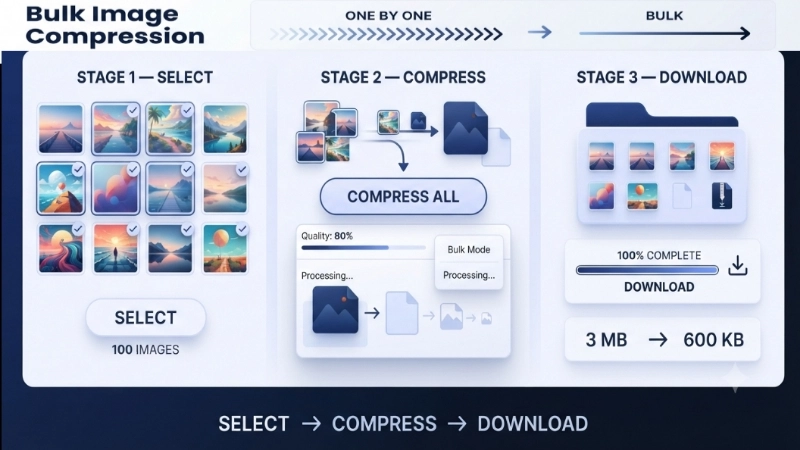
Bulk image compression means compressing many photos at the same time. Instead of opening one photo, compressing it, saving it, and repeating, you just select all your photos at once.
Then you click one button. And the tool compresses every single photo automatically.
Think of it like washing dishes.
You can wash one plate at a time. That takes forever. Or you can put all the plates in the dishwasher at once. Press start. Walk away. Come back when they are done.
Bulk compress images is the dishwasher for your photos.
Bulk photo compression tools work in three simple steps:
- Select all the photos you want to compress (you can select 10, 100, or 1,000 photos)
- Choose your compression settings (like quality level or target file size)
- Click compress and wait a few seconds or minutes
That is it. The tool processes every photo. You get back a folder full of smaller, compressed images.
Method 1: Top Image Fixer (The Best Free Bulk Compressor)
Let me start with my absolute favorite tool for bulk compress images.
Top Image Fixer has a fantastic JPG Compress and PNG Compress tool that handles multiple files at once. It is free, it is fast, and it requires no sign-up.
Here is how to bulk compress images using Top Image Fixer:
Step 1: Open your browser on your phone or computer.
Step 2: Go to Top Image Fixer website.
Step 3: Find the JPG Compress or PNG Compress tool.
Step 4: Look for the option to upload multiple files. It usually says “Upload” or “Add Files.” Some versions allow you to drag and drop a whole folder.
Step 5: Select all the photos you want to compress. You can select 10, 20, 50, or more at once.
Step 6: Choose your compression level. I recommend 80% quality for most photos.
Step 7: Click the Compress or Start button.
Step 8: Wait a few seconds. The tool processes each photo one by one automatically.
Step 9: Click Download All to save all your compressed photos in one zip file.
Direct Tool Link: Click here to bulk compress your images now using Top Image Fixer (Insert your actual tool link here)
Why I love Top Image Fixer for bulk compression:
- It is completely free (no hidden costs)
- No account or email required
- Works on any device (phone, tablet, computer)
- No watermarks on your photos
- You can compress JPG and PNG files
- Processing is fast even for 50+ photos
- The download comes as a zip file (easy to manage)
I use this tool every time I need to bulk images compressor for my work. It takes less than two minutes to compress 100 photos.
![Image Prompt: A computer screen showing a file upload area with 25 image thumbnails. A progress bar shows “Compressing 25 images: 65% complete”. Below, a green download button says “Download All (ZIP)”. Clean, user-friendly interface illustration. 16:9 ratio.]
Method 2: Using Windows Built-in Tools (No Downloads)
Did you know that Windows can batch compress images without any extra software? It is not as powerful as dedicated tools, but it works in a pinch.
Here is how to bulk compress images on Windows:
Step 1: Put all the photos you want to compress into one folder.
Step 2: Select all the photos (press Ctrl + A on your keyboard to select everything in the folder).
Step 3: Right-click on any selected photo.
Step 4: Choose Send to from the menu.
Step 5: Choose Mail recipient from the submenu.
Step 6: A window will pop up asking “What size would you like for your pictures?”
Step 7: Choose Small (800 x 600) or Medium (1024 x 768).
Step 8: Click Attach.
Step 9: Windows creates compressed versions of all your photos and attaches them to a new email.
Step 10: Right-click on any attached photo in the email and select Save as to save the compressed versions to your computer.
This method works well for 10 to 20 photos. For more than that, use a dedicated bulk photo compression tool like Top Image Fixer.
Method 3: Using Mac Built-in Tools (Preview and Automator)
Mac users, you have a hidden superpower called Automator. It can bulk compress images automatically.
Here is the quick method using Preview:
Step 1: Select all the photos you want to compress in Finder.
Step 2: Right-click and choose Open with > Preview.
Step 3: In Preview, you will see all your photos in the sidebar.
Step 4: Select all the photos in the sidebar (Cmd + A).
Step 5: Click File > Export Selected Images.
Step 6: Choose a location to save the compressed photos.
Step 7: Under Format, choose JPEG.
Step 8: Move the Quality slider down to 70% or 80%.
Step 9: Click Choose.
Preview will export every selected photo at the new quality setting. This works great for 50 photos or fewer.
For larger batches (100+ photos): Use Automator. It sounds fancy, but it is actually simple. Search YouTube for “Automator batch compress images” and follow a 3-minute tutorial. Once set up, you can compress 1,000 photos with one click.
Method 4: Using Free Desktop Software (For Regular Users)
If you bulk compress images often, you might want dedicated software on your computer. Here are two free options.
Option A: IrfanView (Windows only, Super Fast)
IrfanView is tiny and lightning fast. It handles batch compress images beautifully.
Step-by-step for IrfanView:
- Download and install IrfanView (free for personal use).
- Open IrfanView.
- Press B on your keyboard (for Batch conversion).
- Click Add and select all the photos you want to compress.
- Check the box that says Use advanced options.
- Click Set advanced options.
- Set JPEG save quality to 80%.
- Click OK.
- Choose an output folder for your compressed photos.
- Click Start.
IrfanView will compress 100 photos in about 10 seconds. It is incredibly fast.
Option B: GIMP with BIMP Plugin (Powerful but Advanced)
GIMP is free like Photoshop. BIMP is a free plugin that adds batch processing.
This option is for people who want total control. It is not for beginners. But if you need to compress 1,000 photos with specific settings, BIMP is amazing.
Batch Compression vs. Single Compression: Which One Do You Need?
Not everyone needs to bulk compress images. Sometimes single compression is better.
Let me help you decide.
| You Should Bulk Compress If… | You Should Compress One by One If… |
|---|---|
| You have more than 10 photos | You only have 1 or 2 photos |
| All photos need the same quality setting | Each photo needs different settings |
| You are preparing a website or portfolio | You are editing a single special photo |
| Your phone storage is almost full | You have plenty of storage space |
| You need to email many photos | You only need to share one photo |
| You are a professional (photographer, real estate, e-commerce) | You are a casual user |
My recommendation: If you have 10 or more photos, use bulk photo compression. It saves time. It saves effort. And modern tools are so good that you lose nothing compared to doing them one by one.
Common Mistakes to Avoid When Bulk Compressing
I have compressed thousands of images in bulk. Let me save you from the mistakes I made.
Mistake #1: Not Keeping Your Originals
Always, always, ALWAYS keep your original photos.
When you bulk compress images, save the compressed versions in a new folder. Do not overwrite your originals.
Why this matters: What if you compress too much? What if you need the high-quality version later for printing? If you deleted the originals, they are gone forever.
The fix: Create a folder called “Original Photos” and another called “Compressed Photos.” Keep both.
Mistake #2: Using the Same Settings for Everything
Not all photos need the same compression level.
- Product photos on a website can be 70% quality (very small files)
- Client portrait previews should be 85% quality (larger but look better)
- Archiving old family photos should be 90% quality (preserve memories)
The fix: Sort your photos into groups before compressing. Group A (website images) compress at 70%. Group B (important photos) compress at 85%.
Mistake #3: Forgetting About Different File Types
JPG and PNG compress differently. PNG files (screenshots, logos) do not get as small as JPG files (photos).
The fix: Separate your JPG and PNG files before batch compress images. Use a JPG tool for photos. Use a PNG tool for graphics.
Mistake #4: Compressing Already Compressed Images
If you compress an image, then compress it again later, the quality gets worse each time.
The fix: Always start from your original, high-quality photos. Do not bulk compress images that have already been compressed.
Real-Life Examples: Bulk Compression in Action
Let me share three true stories about why bulk images compressor tools are essential.
Example 1: The E-commerce Store Owner
Sarah runs an online store selling handmade jewelry. She had 300 product photos. Each photo was 4 MB. Her website took 7 seconds to load. Customers were leaving before the page loaded.
She used Top Image Fixer to bulk compress images to under 300 KB each. Total time: 3 minutes. Her website now loads in 2 seconds. Her sales increased by 35% in the next month.
Example 2: The Wedding Photographer
Mark shot a wedding and had 800 photos to deliver. The full-quality photos were 10 GB total. He could not email them. He could not upload them easily.
He used bulk photo compression to create a preview gallery. He compressed all 800 photos to 500 KB each. The total became 400 MB. He uploaded them in 10 minutes and sent the link to the happy couple.
Example 3: The Parent with a Full Phone
Lisa had 5,000 photos of her kids on her iPhone. Her phone was completely full. She could not take new photos. She did not want to delete any memories.
She downloaded all her photos to her computer. She used a bulk compress images tool to compress everything to 50% of the original size. She saved 15 GB of space. She put the compressed photos back on her phone. She kept every memory. And she could take new photos again.
Frequently Asked Questions (FAQs)
Let me answer the questions people ask most often about bulk compress images.
Q1: How many photos can I compress at once?
It depends on the tool. Top Image Fixer can handle 20-30 photos per batch for free. Desktop tools like IrfanView can handle hundreds or thousands. Some paid tools have no limits.
Q2: Does bulk compression reduce quality more than single compression?
No. Bulk images compressor tools apply the same compression to each photo individually. The quality is exactly the same as if you compressed them one by one.
Q3: Can I bulk compress images on my phone?
Yes. Use the Top Image Fixer website in your phone’s browser. You can select multiple photos from your camera roll. The tool will compress them all and let you download them as a zip file.
Q4: What is the best free bulk photo compression tool?
I am biased, but I believe Top Image Fixer is the best. It is free, easy to use, and works on any device. For desktop users, IrfanView (Windows) is excellent.
Q5: How do I bulk compress images without losing quality?
Use lossless compression. Most bulk tools offer a lossless option. The file will not get as small (maybe 10-20% reduction), but the quality stays perfect.
Q6: Can I batch compress images of different file types at once?
Some tools can handle mixed file types. Top Image Fixer has separate JPG and PNG tools. It is better to separate them first for best results.
Q7: How long does bulk compression take?
For 50 photos: 30 seconds to 2 minutes. For 500 photos: 5 to 15 minutes. It depends on your internet speed (for online tools) and your computer speed (for desktop tools).
Q8: Will bulk compressed images work for printing?
It depends on your compression settings. For printing, use high quality (90% or higher). For emails or websites, 70-80% is fine.
Q9: Can I undo bulk compression?
No. Once you save compressed images, you cannot get the original data back. That is why I always say: keep your originals in a separate folder.
Q10: Is it safe to use online bulk compressors?
With trusted tools like Top Image Fixer, yes. They do not store your images. The compression happens in your browser. Your photos never leave your device. Always read the privacy policy before using any online tool.
My Personal Workflow for Bulk Compression
Let me show you exactly what I do when I need to bulk compress images.
For website images (50-100 photos):
- I put all the photos in a folder called “Website Originals”
- I open Top Image Fixer in my browser
- I upload all the photos at once
- I set quality to 75%
- I click compress and wait 1-2 minutes
- I download the zip file
- I extract the compressed photos to a folder called “Website Compressed”
- I upload the compressed folder to my website
For phone storage cleanup (1,000+ photos):
- I connect my phone to my computer
- I copy all photos to a folder on my computer
- I use IrfanView to batch compress at 80% quality
- I save the compressed photos to a new folder
- I delete the original large photos from my phone
- I copy the compressed photos back to my phone
For email attachments (10-20 photos):
- I select all the photos in a folder
- I right-click and choose Send to > Mail recipient (Windows)
- I choose the “Small” size option
- I attach the compressed versions to my email
This workflow takes me less than 5 minutes for 100 photos. It used to take me an hour. Bulk compression changed my life.
Conclusion: Stop Wasting Time, Start Bulk Compressing
You came here asking about bulk compress images. Now you know exactly what it means and how to do it.
You know why bulk compression saves you hours of work. You know the best free tool (Top Image Fixer). You know how to do it on Windows, Mac, and your phone. You know what mistakes to avoid and when to use bulk compression vs. single compression.
Here is the honest truth. Doing things one by one is for people who do not know better. Now you know better.
Your actionable plan for today:
- Find a folder on your computer with at least 20 photos.
- Go to Top Image Fixer JPG Compress tool.
- Upload all 20 photos at once.
- Set quality to 80%.
- Click compress.
- Download the zip file.
- Compare the total file size before and after.
- Notice how you just saved 15 minutes of work.
Do this once, and you will never go back to compressing images one by one. You will wonder why you ever wasted so much time.
Now go ahead. Gather those photos. Compress them in bulk. Save your time for things that matter. You have the knowledge. You have the tools. Go make your digital life faster and easier.
Internal Linking Suggestions for Your Website:
- Link from this article to: “How to Compress Images for Website Speed (Complete Guide)”
- Link from this article to: “JPG vs PNG vs WebP: Which Format Should You Use for Bulk Compression?”
- Link from this article to: “How to Free Up Storage Space on Your Phone by Compressing Photos”
One last thing: Bookmark the Top Image Fixer bulk compress tool right now. The next time you have 50 photos to compress, you will thank me. Happy compressing!